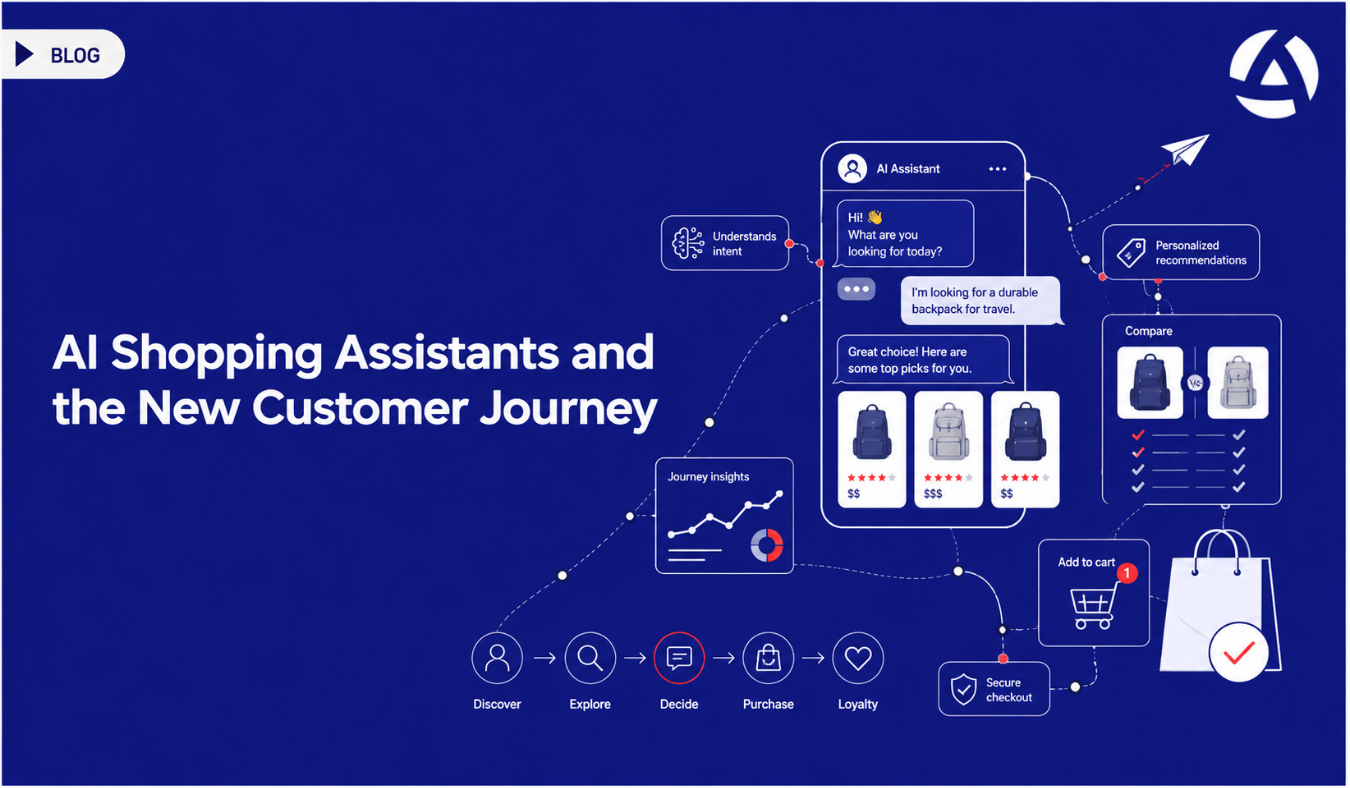
AI Shopping Assistants and the New Customer Journey
Product discovery is becoming conversational, personalized, and increasingly agent-driven. The opportunity for retailers is significant, but so are the new experience risks.
AI Shopping Assistants and the New Customer Journey: What Retailers Need to Know in 2026
AI shopping assistants help consumers discover, research, compare, and sometimes purchase products through a conversational interface. In 2026, the biggest change is not simply better recommendations. It is the emergence of a new layer between shoppers and retailers, one that can interpret intent, evaluate trade-offs, build carts, and take limited actions with the shopper's permission.
Online shopping has traditionally required customers to do most of the work. They enter keywords, open product pages, compare specifications, read reviews, check prices, and decide which information to trust. Even when recommendation engines help, the customer still has to translate a personal need into filters and product categories.
AI shopping assistants change that interaction model. A shopper can describe the outcome they want in natural language, clarify priorities through a conversation, and ask the system to compare options against several constraints at once. The interface starts with intent rather than a product name.
This shift is already visible across major platforms. Google is building agentic shopping and checkout capabilities around its Universal Commerce Protocol and Universal Cart. OpenAI is expanding product discovery and comparison inside ChatGPT. Amazon has brought product research, comparisons, price history, deal tracking, cart building, and selected automated purchasing capabilities together under Alexa for Shopping.
For customer experience teams, this creates a new question: what happens when the retailer no longer controls the first, and sometimes most influential, part of the shopping journey?
What Are AI Shopping Assistants?
An AI shopping assistant is a conversational system that helps a customer complete one or more parts of the shopping journey. Depending on the platform and retailer integration, it may help the user define a need, discover products, compare features, summarize reviews, monitor prices, build a cart, or complete a transaction after receiving permission.
The term covers a wide range of experiences. Some assistants operate inside a retailer's own website or app. Others sit on broader AI, search, marketplace, or device platforms and may compare products across multiple sellers.
How AI shopping assistants differ from traditional recommendation engines
| Capability | Traditional recommendation engine | AI shopping assistant |
|---|---|---|
| Primary input | Clicks, purchase history, categories, and product similarity | Natural-language needs, stated preferences, context, and behavioral data |
| Interaction style | One-way suggestions such as “You may also like” | Multi-turn conversation that can clarify priorities and constraints |
| Decision support | Surfaces related or popular products | Explains trade-offs, compares options, and narrows a shortlist |
| Data scope | Usually limited to one retailer or marketplace | May combine retailer data, public information, reviews, and multiple sellers |
| Ability to act | Usually sends the user to a product or cart page | May add items, track prices, initiate checkout, or purchase with approval |
The distinction matters because recommendation engines optimize product exposure, while AI shopping assistants increasingly shape the reasoning that comes before the choice. They do not only answer “Which products are similar?” They attempt to answer “Which option best fits this person's situation, and why?”
The new interface for commerce is not necessarily a product page. It may be a conversation in which a shopper describes a problem and expects the AI to assemble the best path forward.
Why AI Shopping Assistants Matter in 2026
AI-assisted shopping is not new, but three developments have moved it from a recommendation feature toward a new commerce layer.
1. Product discovery is moving into general AI platforms
Consumers can now begin product research inside the same AI tools they use for work, travel planning, learning, or everyday questions. This reduces the distance between an initial need and a product recommendation. Instead of deciding which retailer to visit first, the shopper may ask an AI platform to identify the right category, explain the criteria, and produce a shortlist.
2. Commerce protocols are connecting assistants to retailer systems
Product discovery becomes more powerful when an assistant can access structured product data, current prices, inventory, carts, loyalty information, and payments. Google's Universal Commerce Protocol and OpenAI's Agentic Commerce Protocol are examples of the infrastructure being developed to connect conversational interfaces with merchant systems.
3. Assistants are beginning to take action
The experience is expanding beyond advice. Google has introduced a Universal Cart designed to bring products from participating retailers into one intelligent cart. Amazon's Alexa for Shopping can support price tracking, personalized deal discovery, cart building, routine purchases, and selected agentic purchasing scenarios. OpenAI's shopping experience is also moving toward richer product discovery and supported checkout experiences.
These developments do not mean that fully autonomous shopping has become the default. They show that the technical boundary between recommendation and transaction is becoming thinner.
What Consumers Actually Want from AI Shopping
Consumer research in 2026 points to a clear pattern. People are increasingly open to using AI for research, comparison, and convenience, but they are considerably more cautious about allowing it to make final purchase decisions.
Frequent reliance among current AI research users
Adobe's global survey of 4,000 customers found that among people who already use AI-powered platforms for research, 42% always or frequently rely on them as a primary source for advice, shopping, or troubleshooting.
AI is already supporting product research
NRF and IBM's research covering 18,000 global consumers found that 41% use AI assistants to research products, 33% use them to look for reviews, and 31% use them to search for deals.
Full decision delegation remains limited
Gartner found that willingness to let AI make purchase decisions reached only 11% in lower-stakes categories. Consumers showed greater openness to AI narrowing choices than completing the decision itself.
The message for retailers is straightforward: customers currently value assistance more than autonomy. They want AI to reduce the effort required to understand products, compare prices, find deals, and narrow a decision. They are less willing to surrender control over the final choice, especially when the purchase is expensive, personal, or difficult to reverse.
Trust is also conditional. Adobe found that 70% of customers consider it important for personalized offers and recommendations to feel human rather than automated or robotic. Gartner reported that 54% of consumers who used AI while shopping for a recent purchase felt they had to double-check all the information provided, while 62% said the information ended up wasting their time.
Convenience is valuable only when it reduces effort. An assistant that produces irrelevant recommendations, stale prices, or claims that require extensive verification does not simplify shopping. It moves the work to a different part of the journey.
How AI Changes the Customer Journey
The conventional e-commerce funnel starts with acquisition channels and moves through search, product pages, comparison, cart, checkout, and post-purchase service. AI does not remove these stages, but it can combine, reorder, or hide them from the shopper.
Need expression
The shopper describes a goal, use case, problem, budget, or preference in natural language.
Clarification
The assistant asks follow-up questions and converts an unclear need into decision criteria.
Comparison
Products are evaluated against the stated criteria, reviews, price, availability, and trade-offs.
Handoff or action
The shopper visits a retailer, adds products to a cart, or approves a supported transaction.
Post-purchase
Delivery, support, returns, warranties, and product performance determine whether the promise was accurate.
The first brand interaction may happen without the brand
A customer can form an opinion about a retailer's products before visiting its website. The AI-generated summary, comparison, ranking, or explanation may become the first meaningful brand touchpoint, even though it appears on a third-party platform.
Product data becomes part of customer experience
Incomplete specifications, inconsistent naming, outdated prices, weak imagery, unclear compatibility information, or missing delivery details can now affect whether an AI system understands and recommends a product. Product information management is no longer only an operational or merchandising concern. It directly influences the quality of AI-mediated experiences.
Comparison becomes more contextual
Traditional comparison tables assume that every shopper values the same attributes. A conversational assistant can prioritize different criteria for different people. A feature that matters to one customer may be irrelevant to another. This creates the potential for more useful recommendations, but it also raises the standard for accuracy and reasoning.
Conversion may happen with fewer visible interactions
A shopper may arrive on a product page after completing most of the research elsewhere. Page views and time on site may decline even if purchase intent is stronger. Retailers will need to interpret these shorter journeys carefully rather than assuming that fewer interactions indicate weaker engagement.
Post-purchase experience becomes the moment of truth
An AI assistant can describe a product and recommend a retailer, but the actual experience still depends on fulfillment, delivery, setup, support, returns, and product quality. If the promise created by the assistant does not match reality, customers may blame the platform, retailer, brand, or all three.
The New Customer Experience Risks
AI shopping assistants can remove friction, but they also introduce new failure points that do not fit neatly into traditional website analytics.
Incorrect or outdated information
Prices, stock, delivery times, product specifications, and promotions change frequently. A confident answer based on stale data can create disappointment before the customer even reaches checkout.
Weak recommendation relevance
An assistant may misunderstand a preference, overvalue one attribute, or overlook a compatibility requirement. Poor recommendations create more verification work and reduce trust in the experience.
Unclear commercial influence
Customers need to understand when a result is organic, sponsored, commission-based, or limited by a platform's merchant coverage. A lack of transparency can make every recommendation feel questionable.
Loss of control
Automation becomes uncomfortable when customers cannot review, edit, pause, or reverse an action. Confirmation steps and visible controls are essential, particularly for expensive or sensitive purchases.
Broken handoffs
The AI may recommend an item that is unavailable in the selected size, region, or delivery window. A smooth conversation followed by a confusing retailer page creates a sharp experience gap.
Unclear accountability
When an AI-supported purchase goes wrong, customers may not know whether to contact the assistant platform, retailer, brand, payment provider, or delivery company. Resolution ownership must be explicit.
These risks show why the AI shopping experience cannot be evaluated only through conversion. A system may increase clicks or purchases while also creating mistrust, higher return rates, more support contacts, or frustration that appears later in the journey.
What Retailers Should Do Next
Retailers do not need to predict which AI platform will dominate. They need to make their customer experience understandable, reliable, and measurable across whichever interfaces customers choose.
- Strengthen product data quality. Keep specifications, compatibility details, prices, availability, delivery information, policies, and structured product attributes accurate and consistent.
- Design for assisted decisions before full autonomy. Prioritize comparison, explanation, review summaries, deal discovery, and shortlist creation. These are the use cases where consumer readiness is currently strongest.
- Make the reasoning visible. Explain why a product is recommended, which criteria were used, what trade-offs exist, and when the underlying information was last checked.
- Preserve customer control. Let users edit preferences, remove products, change sellers, review the cart, confirm payment, and move to a human-supported channel when needed.
- Prepare the handoff. Ensure that links from AI platforms lead to the correct product, variant, region, language, price, and stock state. Carry the customer's context forward wherever possible.
- Clarify responsibility. Make support, cancellation, return, refund, and warranty ownership easy to understand before and after purchase.
- Listen for new forms of friction. Track complaints about incorrect AI information, irrelevant recommendations, difficult verification, privacy concerns, missing human support, and gaps between the recommendation and the delivered experience.
Do not treat AI visibility as a substitute for customer experience
Retailers will understandably focus on whether their products appear in AI-generated answers. Visibility matters, but being recommended is only the beginning. The product must still be right for the shopper, the information must be correct, the purchase path must work, and the post-purchase experience must meet the promise.
A retailer that optimizes only for AI discovery may increase exposure without building trust. A stronger strategy connects product visibility, recommendation quality, transaction reliability, and customer feedback.
How to Measure an AI-Assisted Shopping Experience
Traditional e-commerce metrics remain useful, but they do not fully explain whether an AI shopping assistant helped the customer make a confident decision. Retailers need a measurement framework that connects behavior with perception.
| Experience area | What to measure | Signals to monitor |
|---|---|---|
| Recommendation relevance | Whether the shortlist reflects the customer's actual needs and constraints | Shortlist acceptance, recommendation edits, “not relevant” feedback, related complaint topics |
| Information accuracy | Whether prices, stock, specifications, delivery details, and policies match the retailer experience | Price mismatch complaints, out-of-stock landings, support contacts, abandoned handoffs |
| Decision effort | Whether AI reduces or increases the work required to reach a confident choice | Repeated queries, verification behavior, time to shortlist, customer comments about confusion |
| Trust and control | Whether customers understand why an item is recommended and feel able to control the process | Confirmation cancellations, privacy concerns, requests for human help, trust-related sentiment |
| Handoff quality | Whether the transition from the AI platform to the retailer preserves context and availability | Landing-page errors, variant mismatches, cart loss, drop-off after referral |
| Post-purchase fit | Whether the recommended product and seller deliver the expected outcome | Returns, exchanges, review themes, product-fit complaints, warranty and support contacts |
Where referral and journey metadata are available, retailers should compare AI-assisted journeys with direct search, paid media, social, marketplace, and retailer-site journeys. The goal is not only to determine which channel converts. It is to understand which channel creates informed, confident customers who are less likely to encounter problems later.
The Alterna CX Perspective: Listen Beyond the Interface
As product discovery spreads across AI platforms, retailers will have less direct visibility into some of the conversations that shape customer expectations. This makes the feedback customers provide after the recommendation even more important.
Customers may describe an AI-assisted experience in an app review, post-purchase survey, support ticket, social media comment, chat conversation, call center interaction, product review, or return reason. Each source captures a different part of the journey.
Questions customer feedback can help answer
Was the recommendation relevant?
Identify whether customers describe suggested products as useful, generic, unsuitable, repetitive, or disconnected from their stated needs.
Did the information match reality?
Detect recurring complaints about price, stock, size, compatibility, delivery, product features, or policy information that differed from the recommendation.
Where did trust break down?
Track language related to bias, sponsorship, privacy, lack of explanation, excessive automation, or difficulty reaching a human.
Was the handoff seamless?
Examine whether customers reached the right product and variant, retained their cart context, and completed the next step without repeating work.
Which issues appear after purchase?
Connect recommendation claims with returns, product-fit issues, support contacts, and review themes to see whether the promised outcome was delivered.
How does the experience vary?
Where metadata allows, compare feedback by product category, market, channel, journey stage, customer segment, and time period.
Alterna CX helps organizations bring structured and unstructured customer signals together and analyze them by topic, sentiment, intent, journey, segment, and experience driver. This makes it easier to move from scattered comments to recurring root causes and prioritized actions.
From AI-Generated Expectations to Real Customer Outcomes
Retailers will need to evaluate the full chain of experience rather than treating AI-assisted product discovery as an isolated channel.
Trusted by Leading Brands










- Listen: Collect customer feedback across surveys, reviews, conversations, support channels, and social sources.
- Unify: Bring direct and indirect customer signals into one analytical structure.
- Analyze: Identify topics, sentiment, intent, experience drivers, and emerging patterns in open-ended feedback.
- Compare: Examine how experience changes by journey stage, channel, segment, market, product, and time period.
- Act: Route critical issues to the relevant teams, track actions, and measure whether the experience improves.
The Retail Opportunity Is Bigger Than Automated Checkout
The most important value of AI shopping assistants may not be their ability to complete a purchase. It may be their ability to reduce the cognitive effort that comes before one.
Shopping decisions often require customers to translate vague needs into technical criteria, evaluate unfamiliar product language, compare trade-offs, and judge the credibility of reviews and promotions. A well-designed assistant can make that process easier. It can help a customer understand what matters before pushing them toward a product.
That opportunity comes with a clear condition: the system must earn trust through accuracy, relevance, transparency, and customer control. Retailers that treat AI shopping as another promotional surface will miss the point. Retailers that use it to help customers make better decisions can create a more useful experience from discovery through post-purchase support.
The customer journey is not disappearing. It is becoming more conversational, more distributed, and more difficult to observe through clicks alone. The organizations that combine behavioral data with the customer's own words will be better positioned to understand what is working, where trust is breaking, and which improvements matter most.
Sources and Methodology Notes
This article was prepared using primary platform announcements and institutional consumer research available as of July 27, 2026.
- Adobe, 2026 AI and Digital Trends Consumer Report : Global research conducted by Oxford Economics with 4,000 customers, covering AI-supported research, recommendations, convenience, trust, and consumer control.
- National Retail Federation and IBM, Own the Agentic Commerce Experience : 2026 research drawing on 18,000 global consumers and retail leaders.
- Gartner, Consumers Want AI Shopping Help, But Not AI Purchase Decisions : U.S. consumer research on decision support, autonomy, accuracy, and verification effort.
- Google, Introducing the Universal Cart and More Ways to Help You Shop : May 19, 2026 announcement covering Universal Cart and Google's agentic commerce direction.
- OpenAI, Powering Product Discovery in ChatGPT : March 24, 2026 announcement covering richer product discovery and Agentic Commerce Protocol support.
- Amazon, Meet Alexa for Shopping : 2026 announcement covering conversational product research, comparisons, price history, deal discovery, cart building, and supported agentic shopping capabilities.
Frequently Asked Questions About AI Shopping Assistants
What is an AI shopping assistant?
An AI shopping assistant is a conversational system that helps users discover, research, compare, and sometimes purchase products based on their needs, preferences, context, and budget.
What is agentic commerce?
Agentic commerce refers to shopping experiences in which AI can take actions on a user's behalf, such as building a cart, tracking a price, initiating checkout, or completing a permitted transaction under defined conditions.
Are consumers ready to let AI shop for them?
Consumers show growing interest in using AI for research, comparisons, reviews, deals, and product recommendations. Current research indicates much lower willingness to let AI make final purchase decisions without customer involvement.
How do AI shopping assistants affect customer experience?
They can reduce search and comparison effort, personalize recommendations, and simplify transactions. They can also create new problems related to inaccurate information, irrelevant recommendations, privacy, commercial transparency, broken handoffs, and unclear support responsibility.
What should retailers optimize for AI shopping assistants?
Retailers should prioritize accurate structured product data, clear policies, current prices and inventory, reliable product pages, transparent recommendations, customer control, seamless handoffs, and measurable post-purchase feedback.
How can retailers measure AI-assisted shopping journeys?
Retailers can combine referral and conversion data with feedback about recommendation relevance, information accuracy, verification effort, trust, handoff quality, returns, and post-purchase product fit.
Will AI shopping assistants replace retailer websites?
AI assistants may absorb more discovery and comparison activity, but retailer websites, apps, stores, fulfillment systems, service teams, and post-purchase channels remain essential to delivering the actual experience.
Understand What Customers Experience Across Every Channel
Alterna CX helps organizations unify customer feedback from surveys, reviews, contact center conversations, support tickets, social channels, and more, then turn recurring themes and root causes into measurable actions.
Request a Personalized Demo