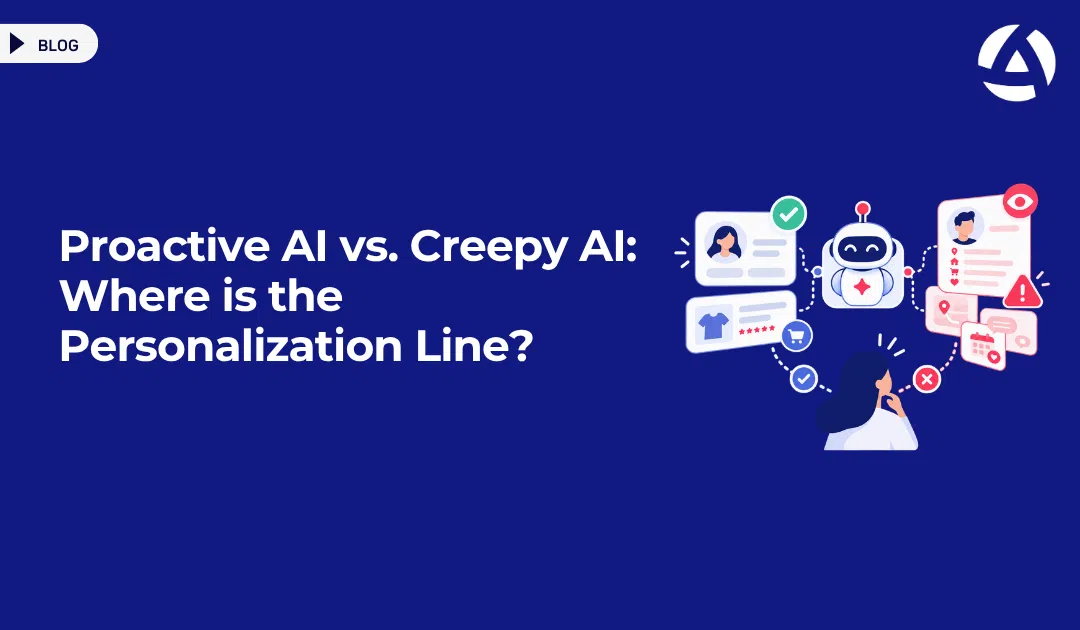
Proactive AI vs. Creepy AI: Where Is the Personalization Line?
AI personalization feels helpful when it uses information the customer expects you to have, saves them effort, and leaves them in charge. It starts to feel intrusive when a brand shows it knows something the customer never shared, guesses at sensitive details, acts without asking, or makes it hard to see or change what the AI is doing. So the line has less to do with how much data a company holds and more to do with how it uses that data: whether the customer expected it, understands it, benefits from it, and can control it.
Personalization has been on CX roadmaps for years, and the basics haven't changed much. Remember what customers prefer. Recommend things that are actually relevant. Don't ask for information they've already given you. Make each interaction a little easier than the last.
AI raises the stakes. Instead of reacting to what customers do, it can start working out what they'll need next. It can predict intent, pick content, suggest an action, prepare an answer before the question comes, or reach out before the customer does.
When this works, customers barely notice the effort they didn't have to make. When it misfires, their first thought is: How did they know that?
The same intelligence that makes personalization useful can make it feel invasive when the customer has no idea why it's happening.
That puts CX teams in an awkward spot. Personalizing more is easy. The harder part is knowing where personalization stops helping and starts wearing down trust.
Why AI Personalization Is Becoming More Proactive
Traditional personalization mostly reacted to things customers did in plain sight. Someone browsed running shoes, and the next email featured running shoes. A subscriber watched a documentary, and the platform suggested another one. A frequent flyer picked an aisle seat, and the airline remembered it next time.
Proactive AI works differently. It pulls several signals together, reads the context, and decides what the customer probably needs before they ask. In practice, that might look like:
- Warning a traveler about a likely missed connection before the delay is even announced.
- Suggesting a simpler service option based on a customer's recent support tickets.
- Noticing that a customer keeps getting stuck on the same feature and offering help at the right moment.
- Recommending a product based on what the customer is doing right now, not on a broad demographic segment.
- Giving a service agent a suggested next step before the customer has to explain the whole issue again.
Each of these saves the customer a step they would otherwise have to take themselves.
Consumers seem open to this, as long as it actually helps. In Adobe's September 2026 research, three in five consumers said they would be more loyal to a brand that offers proactive AI experiences designed to anticipate their needs.
Being proactive doesn't earn trust by default, though.
The Personalization Trust Gap
The picture gets more complicated when you look at personalization and trust side by side.
Loyalty can go up
Adobe found that three in five consumers would be more loyal to a brand offering proactive AI experiences designed to anticipate their needs.
Adobe, September 2026Disclosure builds confidence
According to Adobe, 69% of consumers feel more confident in brands that make it clear from the start when they're talking to an AI agent.
Adobe, September 2026Trust in AI is still low
Qualtrics' 2026 research found that only 29% of customers trust organizations to use AI responsibly. Misuse of personal data is their top concern with automated interactions.
Qualtrics research, 2026Gartner's findings point the same way. At its 2026 Marketing Symposium, Gartner reported that nearly half of customers find personalized experiences creepy, irrelevant, or both.
So customers want relevance and less effort, but more data and more prediction don't automatically give them either. Whether personalization lands well depends on how the company uses what it knows.
Helpful Personalization vs. Creepy Personalization
“They made this easier for me.”
- The recommendation matches what the customer needs right now.
- The customer can tell why the brand has this information.
- The benefit is immediate.
- The customer can change or dismiss the recommendation.
- The AI removes a step instead of adding one.
- The level of personalization fits the situation.
“Why do they know this about me?”
- The data source is unclear or unexpected.
- The AI reveals something it inferred, not something the customer shared.
- Sensitive information is used for a trivial interaction.
- The customer can't easily opt out or correct the AI.
- The brand acts before the customer has really agreed to it.
- The personalization clearly serves the company more than the customer.
Both columns could be powered by exactly the same AI. What separates them is the gap between what the customer expects and what the company actually does.
Five Principles for Trusted AI Personalization
Make the benefit obvious
Customers should see right away how personalization makes things easier, faster, or more relevant for them.
Use expected context
Data from the current relationship or interaction is easier to accept than external or inferred data the customer didn't know you had.
Explain the AI
Tell customers when AI is involved, and give a plain reason for important recommendations or actions.
Preserve control
Customers should be able to turn down a suggestion, change their preferences, correct wrong assumptions, and reach a person when it matters.
Match data to value
The more sensitive the data, the bigger the benefit to the customer needs to be.
When Proactive AI Crosses the Personalization Line
1. Hidden inference
AI can pick up a lot from ordinary behavior: financial pressure, health concerns, a move, a new baby. Even when the inference is correct, saying it out loud to the customer can be unsettling.
2. Sensitive data without proportional value
Using very personal information to solve a small problem feels out of balance. The customer gives up more than they get back.
3. Acting before permission is clear
Suggesting an action and taking it are two very different things. Changing a booking, escalating a case, spending money, or contacting someone on the customer's behalf needs much more confidence and much clearer permission.
4. Repetition that becomes surveillance
A recommendation that helps once can feel uncomfortable by the tenth time. When personalization follows the customer into every interaction, the brand starts to feel hard to get away from.
5. Personalization based on the wrong context
Getting personalization wrong can be worse than not personalizing at all. It tells the customer you're using their data without really understanding them.
6. No way to correct the system
It gets frustrating fast when one wrong assumption keeps shaping every recommendation and the customer has no obvious way to fix or reset it.
The Five-Question Personalization Test
Before launching a proactive AI experience, CX teams can run it through five questions.
Would the customer expect us to know this?
If the data source would surprise the customer, the trust risk goes up.
Is the customer benefit clear?
The more personal the data, the bigger the improvement needs to be.
Can we explain why the AI made this recommendation?
People trust recommendations more when the reasoning makes sense to them.
Can the customer say no?
Customers should be able to reject, correct, opt out, or reach a person when the situation calls for it.
Would this still feel appropriate if the customer saw the data behind it?
If the experience only feels acceptable as long as the data behind it stays hidden, treat that as a warning sign.
What CX Teams Should Measure
Click-through rate won't tell you whether AI personalization is helping the customer relationship. A highly personalized recommendation can drive more engagement and still chip away at trust.
| Measurement area | Example signals | Why it matters |
|---|---|---|
| Recommendation acceptance | Clicks, accepts, saves, completed actions | Shows whether personalization is useful enough to act on |
| Opt-out behavior | Preference changes, personalization disablement, unsubscribe | Shows when personalization is too frequent or too intense |
| Correction behavior | Preference edits, rejected assumptions, repeated corrections | Points to where AI context or customer profiles are wrong |
| Trust signals | Survey comments, reviews, trust scores, privacy concerns | Shows whether customers see the experience as appropriate |
| Customer effort | Task completion, repeated steps, contact rate, escalation | Tests whether proactive AI actually makes the journey easier |
| Sentiment | Positive, neutral, negative sentiment before and after interaction | Shows whether personalization makes the experience feel better or worse |
| Complaint topics | Privacy, relevance, frequency, incorrect data, unwanted automation | Brings up recurring trust problems that engagement metrics can hide |
| Business outcomes | Conversion, retention, churn, repeat purchase, loyalty | Ties personalization to long-term value, not just short-term clicks |
Conversion still matters. But a more useful question to ask is: Did the experience create value without making the customer less willing to trust us next time?
The Alterna CX Perspective: Personalization Needs Context and Customer Feedback
Customer profiles alone won't show you where the personalization line is. You also need to know how customers react to the experiences those profiles produce.
Listen for trust signals
Look across surveys, reviews, support conversations, complaints, and social feedback for recurring concerns about privacy, relevance, control, and unwanted automation.
Connect the context
Bring customer history, journey stage, feedback, and operational data together so personalization reflects the customer's actual situation, not isolated data points.
Protect what does not need to be exposed
Personal information masking limits unnecessary exposure of identifiable data while keeping the experience signals teams need for analysis.
A customer might be glad you remember their preferred support channel and still object when an AI system draws a sensitive conclusion from that same history.
That's why personalization rules shouldn't be set only by what the technology can predict. They should also reflect what customers keep telling you feels helpful, unnecessary, confusing, or intrusive.
The Best Personalization Should Feel Obvious, Not Impressive
It's tempting to judge AI personalization by how clever it looks. Customers use a simpler test: Did this make things easier for me?
The best proactive experiences rarely surprise anyone. The brand knows enough to remove friction, but not so much that the customer starts wondering where the information came from or why it was used.
AI will keep making it easier to infer more, predict more, and act sooner. Not every prediction needs to turn into a customer interaction, though. The brands that handle this well will be the ones that know when using what they know actually improves the experience, and when it's better to hold back.
Sources and Methodology Notes
This article draws on public research and industry analysis available as of September 28, 2026.
- Adobe, The Agentic AI Acceptance Curve: How Consumer Trust in AI Agents Is Reshaping Customer Experiences , September 9, 2026. Adobe reports that three in five consumers would be more loyal to brands offering proactive AI experiences and that 69% feel more confident when brands disclose AI interactions from the outset.
- Gartner Marketing Symposium/Xpo 2026: Day 3 Highlights . Gartner reports that nearly half of customers find personalized experiences creepy, irrelevant, or both, and argues that personalization needs stronger fundamentals and responsible AI use going forward.
- Qualtrics XM Institute, Consumer Preferences for Privacy and Personalization, 2026. Research based on more than 20,000 consumers across 14 countries examining the trade-off between personalized experiences, data privacy, transparency, and control.
- Qualtrics, How to Close the AI Trust Gap Among Customers and Employees, September 2026. Research drawing on more than 100,000 consumers and employees, including findings on declining comfort with AI, trust in responsible AI use, and concerns about misuse of personal information.
- Alterna CX, Why Personal Information Masking Matters in Customer and Employee Experience Analytics . How to keep experience analytics useful while limiting exposure of personal information.
Frequently Asked Questions About AI Personalization
What is AI personalization?
AI personalization uses machine learning or generative AI to adapt content, recommendations, interactions, or actions to a customer's context, preferences, and behavior.
What is proactive AI in customer experience?
Proactive AI anticipates what a customer is likely to need and offers help, information, or a recommendation before the customer asks for it.
Why can personalization feel creepy?
Personalization tends to feel intrusive when customers don't understand how the company got the information, when sensitive data shows up unexpectedly, or when the AI acts without enough transparency or control.
Does more customer data create better personalization?
Not necessarily. Relevance depends on the quality and context of the data, and on whether the benefit to the customer justifies using it. More data also brings more privacy and trust risk.
How can companies make AI personalization more trustworthy?
Make the customer benefit clear, use context the customer expects you to have, say when AI is involved, explain important recommendations, give customers control, and avoid using sensitive information when it isn't needed.
What should CX teams measure beyond personalization conversion rates?
Beyond conversion, CX teams should track opt-outs, customer corrections, complaints, trust signals, sentiment, customer effort, escalation, retention, and the reasons customers give for finding personalization helpful or intrusive.