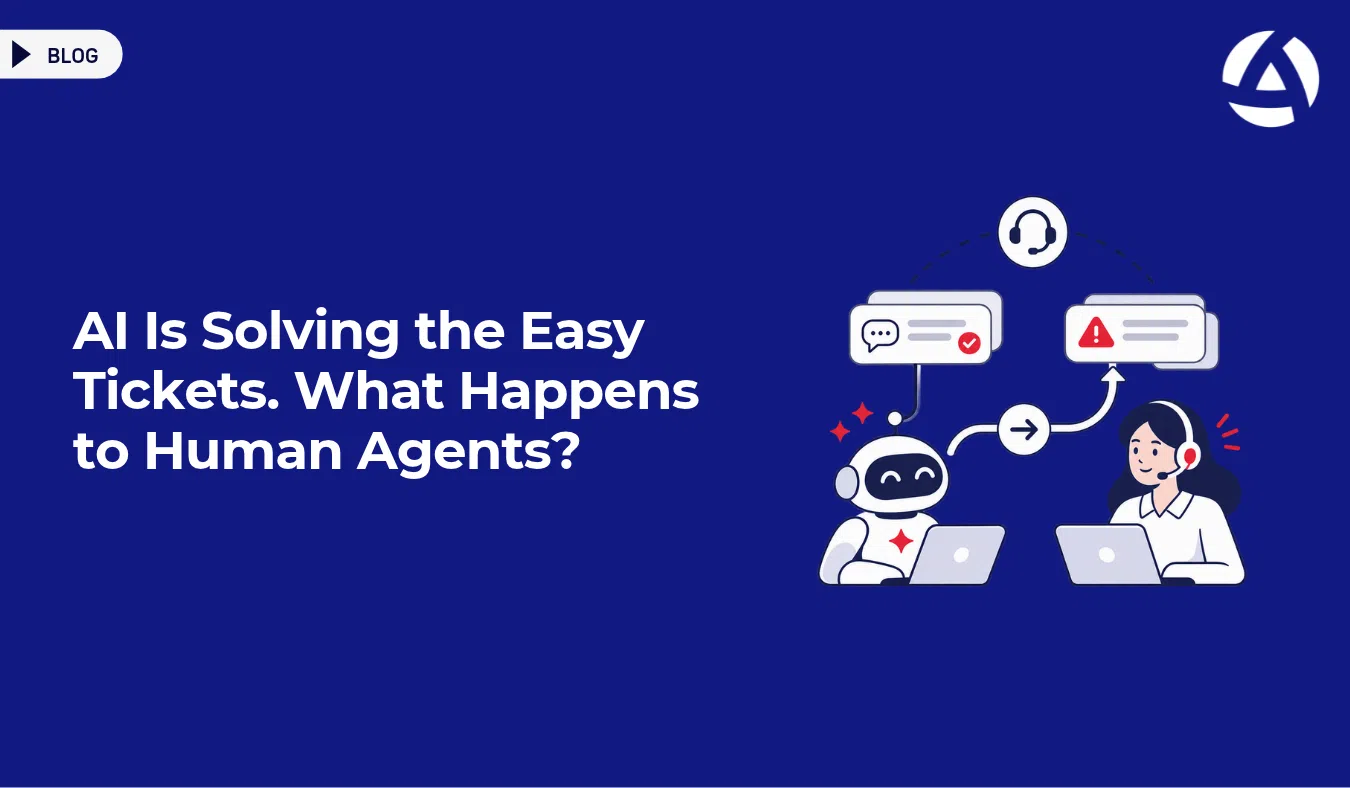
AI Is Solving the Easy Tickets. What Happens to Human Agents?
AI in customer service is not simply replacing human agents. It is changing the mix of work they receive. As AI handles more routine questions and transactions, human agents increasingly deal with complex exceptions, emotional situations, high-value customers, and cases where judgment matters. This means contact centers need to rethink staffing, agent skills, workload, quality measurement, and even familiar metrics such as average handle time.
For the past few years, one question has dominated conversations about AI in customer service:
How many human agents will AI replace?
The latest data suggests that may be the wrong question.
Gartner reported on November 5, 2026 that only 21% of surveyed service and support leaders had reduced human agent headcount because of AI. Among those that did, the average workforce reduction was 16.7% over the previous 18 months.
More interestingly, some organizations are already reversing those decisions.
Seven percent said they had rehired human employees after previous reductions, while another 11% planned to rehire within the next 18 months.
AI may reduce the amount of routine service work. That does not mean the remaining human work becomes smaller. It may become harder.
This creates a very different challenge for CX and contact center leaders.
When the easy tickets disappear, what happens to the people handling everything that remains?
AI Is Reshaping Customer Service, Not Simply Shrinking It
The latest customer service research shows a more complicated picture than the idea of AI simply replacing people.
Reduced agent headcount
Only 21% of surveyed service and support leaders said their organization had reduced human agent headcount because of AI.
Gartner, Nov. 2026Already rehired
Some organizations have already brought human workers back following previous workforce reductions.
Gartner, Nov. 2026Still want human access
Most customers say companies using GenAI for service should still provide a way to reach a human agent.
Gartner, Aug. 2026Expected AI ROI achieved
Only a small share of customer service organizations report achieving the ROI they expected from their AI initiatives.
Gartner, Nov. 2026AI adoption is clearly accelerating.
But organizations are discovering that introducing AI into customer service is not the same as removing the human workforce from it.
In many cases, AI changes where human work begins.
What Happens When AI Takes the Easy Tickets?
Customer service queues have traditionally contained a wide range of interactions.
Some are repetitive and predictable. Others require negotiation, reassurance, creativity, policy interpretation, or emotional judgment.
AI naturally targets the first category.
Routine and repeatable
- Password resets
- Order and delivery status
- Appointment scheduling
- Basic account questions
- Simple policy explanations
- Frequently repeated requests
Complex and sensitive
- Unusual exceptions
- Emotionally charged complaints
- High-value customer issues
- Policy ambiguity
- Negotiation and recovery
- Situations requiring judgment
This creates a selection effect.
The easier interactions leave the human queue first. The interactions that remain become progressively less representative of the historical contact center workload.
This matters because a contact center can become more automated while simultaneously becoming more demanding for the people who still work there.
The Human Agent Role Is Changing
Deloitte describes a similar workforce shift. As AI agents take over routine processes, human workers can focus more on judgment, empathy, trust, and relationship building.
Those are higher-value activities.
They can also be more cognitively demanding.
Exception handler
Resolve situations where normal rules, workflows, or automated recommendations do not fit the customer's circumstances.
Trust builder
Reassure customers when stakes are high, explain decisions, and rebuild confidence after something has gone wrong.
Judgment layer
Decide when policy should be applied literally and when customer context requires a different response.
AI supervisor
Review AI output, correct context, manage escalations, and identify when automated decisions should not be trusted.
McKinsey describes this evolution as a shift from humans handling individual transactions toward supervising AI-driven interactions, managing exceptions, and working on high-sensitivity situations.
That suggests future contact centers may need fewer people doing simple repetitive work, but more people capable of handling ambiguity.
Customers Still Want Access to People
Automation also has a clear customer-side limit.
Gartner's research involving 3,566 B2B and B2C customers found that 50% said their interactions were easier when companies used GenAI.
But 87% said it was essential for companies using GenAI in customer service to provide a way to reach a human agent.
That distinction matters.
Customers are not necessarily rejecting AI.
They are rejecting experiences where AI becomes a barrier.
AI identifies what the customer is trying to accomplish.
Routine issues are handled when confidence is high.
Complexity, emotion, risk, or uncertainty triggers escalation.
The human receives the history without making the customer start again.
The quality of that final step may become one of the most important differentiators in AI-enabled customer service.
Traditional Contact Center Metrics Need More Context
If AI changes which interactions reach humans, historical contact center benchmarks can become misleading.
Consider average handle time.
If AI resolves five-minute routine interactions and human agents receive a larger share of 20-minute complex cases, average handle time for human agents will rise.
That does not automatically mean human performance has declined.
The workload itself has changed.
| Traditional metric | Why it needs context | What to add |
|---|---|---|
| Average Handle Time | Human agents may increasingly receive only complex cases. | Complexity-adjusted handle time and resolution quality. |
| Cases per Agent | Lower volume may hide higher effort and higher-value work. | Effort, complexity, value, and outcome per case. |
| Escalation Rate | Escalation can be positive when AI recognizes its limits correctly. | Appropriate escalation and unnecessary escalation rates. |
| First Contact Resolution | Resolution can fail when AI and human channels lose context. | End-to-end resolution across AI and human interactions. |
| Customer Satisfaction | Aggregate scores can hide differences between AI-only and hybrid journeys. | Satisfaction by resolution path and handoff type. |
| Agent Productivity | Case counts alone ignore emotional and cognitive workload. | Quality, complexity, workload, and employee experience signals. |
The Hidden Risks of the Hybrid Contact Center
Cognitive overload
If AI filters out simple work, agents may move from one difficult interaction directly into another with fewer low-effort cases between them.
Broken handoffs
A customer who has already explained the problem to AI should not have to repeat the entire story after reaching a person.
Automation bias
Human agents may trust an AI recommendation simply because it is presented with confidence, even when important customer context is missing.
Invisible employee strain
Productivity may appear stable while complexity, emotional labor, and employee fatigue increase beneath the surface.
This is why the success of AI in customer service cannot be evaluated only through containment rates or labor savings.
Customer outcomes and employee outcomes need to be measured together.
Understand Both Sides of the Hybrid Service Experience
As AI changes customer service, organizations need visibility into both the customer experience and the employee experience behind it.
Conversation analytics can help teams understand which issues are reaching human agents, which topics create repeated escalation, where sentiment deteriorates, and what is driving difficult interactions.
Analyze conversations at scale
Identify topics, intent, sentiment, emotion, recurring problems, and root causes across contact center conversations.
Find where AI needs help
Examine escalations and recurring contact to understand which journeys remain difficult to resolve through automation.
Listen to employees too
Combine customer signals with employee feedback to understand workload, friction, and the operational realities behind CX.
Alterna 3.0 extends this idea from analysis toward action by combining CX monitoring, AI-assisted investigation, root-cause exploration, suggested next steps, anomaly detection, and reporting workflows.
The Future Contact Center May Have Fewer Easy Conversations
AI will continue to automate customer service.
But the effect on human agents is unlikely to be as simple as replacing one person with one automated system.
The work is being redistributed.
AI takes more of the predictable interactions. Human agents inherit more of the ambiguity, emotion, exceptions, and judgment.
That makes the quality of human work more important, not less.
The organizations that manage this transition well will not ask only how much service AI can automate.
They will also ask:
What kind of work are we leaving for people, and are we designing the experience, tools, metrics, and workforce around that reality?
Sources and Methodology Notes
This article was prepared using public research available as of November 6, 2026.
- Gartner, Survey Finds 21% of Service and Support Leaders Have Reduced Human Agent Headcount Because of AI , November 5, 2026.
- Gartner, Survey Reveals Just 4% of Customer Service Leaders Have Achieved the Expected ROI of Their AI Initiatives , November 4, 2026.
- Gartner, 87% of Customers Say Companies Using GenAI for Customer Service Must Provide Access to a Human Agent , August 4, 2026.
- Deloitte Insights, How Will AI Agents Fit Into the Human Workplace? , September 10, 2026.
- McKinsey, The Symbiotic Enterprise: A New Model for Growth , 2026.
Frequently Asked Questions About AI in Customer Service
Will AI replace customer service agents?
AI is likely to automate a growing share of routine customer service work, but current research does not show widespread elimination of the human service workforce. Human roles are increasingly shifting toward complex cases, exceptions, sensitive interactions, and AI oversight.
What customer service tasks are best suited to AI?
AI is particularly well suited to predictable, repeatable interactions such as information retrieval, order status, scheduling, basic account management, and clearly defined transactions.
Why will human customer service cases become more complex?
When AI successfully resolves simple interactions, those cases no longer reach human queues. The remaining human workload therefore contains a higher proportion of exceptions, emotional situations, ambiguous problems, and interactions requiring judgment.
Do customers still want human customer service?
Yes. Customers may be comfortable using AI for service, but research shows that access to a human agent remains important, particularly when AI cannot resolve the issue or when the interaction is sensitive.
Should contact centers still use average handle time?
Average handle time can still be useful, but it needs additional context. If AI removes simple cases from the human queue, rising handle time may reflect greater case complexity rather than lower agent productivity.
What should companies measure in hybrid AI and human service?
Useful measures include end-to-end resolution, repeat contact, customer effort, escalation quality, AI-to-human handoff quality, complexity-adjusted agent performance, sentiment, customer outcomes, and employee experience.