South Africa’s mobile banking market has a clear group of leaders.
The latest South Africa Everyday Apps oCX Report shows that Absa Bank, FNB Banking, and Standard Bank outperform the rest of the finance sector by a wide margin.
Their oCX scores are 74, 60, and 51. The rest of the sector averages 34.
This gap is not caused by one single factor. The strongest differences appear in service continuity, app usability, transaction variety, and trust.
What Sets South Africa’s Top Three Banks Apart?
- Higher positive sentiment across the overall digital banking experience
- More reliable service continuity
- Better app usability
- Wider and better-executed transaction options
- More stable trust scores over time
The Numbers Show a Clear Performance Gap
The Big Three lead the rest of the finance sector across overall sentiment.
- Top 3 banks: 76% positive, 11% neutral, and 13% negative sentiment
- Rest of the finance sector: 56% positive, 19% neutral, and 25% negative sentiment
This gives the top three a 20-point advantage in positive sentiment. Their negative sentiment rate is also almost half that of the rest of the sector.
The oCX gap is just as clear. Absa Bank, FNB Banking, and Standard Bank score far above the sector average of 34.
This suggests more than small execution differences. These banks are delivering a stronger digital banking experience across several important areas.
Service Continuity Builds Trust
Service continuity is the most discussed topic in finance app reviews. It accounts for 37% of all reviews in the sector.
- Top 3 banks: 85% positive and 9% negative sentiment
- Rest of the finance sector: 72% positive, 8% neutral, and 20% negative sentiment
The leaders have a 13-point advantage in positive sentiment. Their negative sentiment rate is also much lower.
This matters because banking apps need to work consistently. Login failures, crashes, and security errors quickly damage trust.
The report shows that finance apps recorded their lowest oCX scores in August 2024. Users reported problems after updates, including login failures, security warnings, crashes, and frozen screens.
The stronger service continuity scores of the Big Three suggest they handled this period more effectively.
App Usability Creates a Major Advantage
App usability shows one of the largest gaps between the leaders and the rest of the market.
- Top 3 banks: 76% positive, 12% neutral, and 12% negative sentiment
- Rest of the finance sector: 52% positive, 22% neutral, and 26% negative sentiment
The top three hold a 24-point advantage in positive sentiment.
The rest of the sector also has more than twice the negative sentiment rate. This means many customers still struggle with basic app use.
For banking customers, usability affects every digital task. A clear interface, fast navigation, and reliable flows reduce effort and increase confidence.
Transaction Variety Supports a Better Digital Experience
The third major difference is the range and execution of digital transactions.
- Top 3 banks: 70% positive, 18% neutral, and 12% negative sentiment
- Rest of the finance sector: 48% positive, 28% neutral, and 24% negative sentiment
The leaders have a 22-point advantage in positive sentiment.
The rest of the sector records twice the negative sentiment rate. This points to gaps in both feature breadth and execution.
The high neutral score among competitors may also show that many customers do not fully use available features. Usability issues may prevent them from exploring the app in more depth.
Trust Remains Consistently High
Trust is another area where the Big Three stand out.
Absa Bank, FNB Banking, and Standard Bank maintained trust scores above 86 throughout the year. This was well above the rest of the finance sector.
This consistency matters because the market experienced significant volatility, especially during the August 2024 update problems.
While other finance apps saw larger changes in trust, the top three maintained stable customer confidence.
That points to stronger platform management, clearer customer communication, and more reliable digital experiences.
What Competitors Can Learn
The data suggests four priorities for banks that want to close the gap:
- Improve service continuity: Reduce crashes, login problems, and update-related failures.
- Simplify app journeys: Make key banking tasks easier to find and complete.
- Expand transaction options: Offer more useful digital services without adding complexity.
- Protect trust: Communicate clearly during outages, security events, and major updates.
The strongest banks are not winning because of one feature. They are delivering a more consistent experience across reliability, usability, functionality, and trust.
Why the Gap Becomes Harder to Close
The disadvantages faced by smaller finance apps often reinforce one another.
A customer may experience an unreliable app, a confusing interface, and limited transaction options at the same time. When these problems appear together, the result is not one isolated issue. It becomes a poor end-to-end banking experience.
This can create a damaging cycle:
- Poor usability pushes customers away from digital channels.
- Lower digital use reduces familiarity and confidence.
- Lower engagement limits awareness of available features.
- Repeated problems weaken trust in the brand.
- Weaker trust makes customers more open to competitor offers.
The Business Value of Digital Excellence
For the Big Three, stronger digital performance can create several business advantages.
- Lower operating costs: Fewer digital problems can reduce call center demand and branch visits.
- Higher digital adoption: Positive app experiences encourage customers to complete more banking tasks online.
- More cross-selling opportunities: Customers who trust the app are more likely to explore additional products.
- Better retention: A strong digital experience reduces the appeal of switching to another bank.
- Stronger differentiation: In a crowded market, the digital experience becomes a major reason to choose one bank over another.
Why Small Improvements May Not Be Enough
The gap between the leaders and the rest of the market is too large to be explained by one weak feature.
The Big Three record 76% positive sentiment overall, compared with 56% for the rest of the finance sector. Their oCX scores are also far above the sector average of 34.
The same pattern appears across service continuity, usability, transaction variety, and trust.
This suggests a broader capability gap. Competing banks may need to improve technology, product design, quality assurance, and customer communication at the same time.
The Path Forward Requires Broader Transformation
Closing the gap will require more than adding a few features.
Negative sentiment for app usability is 26% among the rest of the sector, compared with 12% for the Big Three. Transaction variety shows the same pattern: 24% negative sentiment versus 12%.
These results point to deeper platform and experience problems.
The disruption seen in August 2024 reinforces this point. Many finance apps suffered from failed updates, crashes, login problems, and security warnings. The leaders maintained greater stability.
To compete more effectively, banks should strengthen:
- Platform reliability
- Quality assurance before app releases
- Customer communication during disruptions
- Core journey design
- Feature usability and discoverability
Conclusion: A New Standard for Digital Banking
Absa Bank, FNB Banking, and Standard Bank show that strong mobile banking performance is the result of sustained investment and consistent execution.
Their advantage comes from doing the basics well at scale: keeping services available, making apps easy to use, offering useful transaction options, and protecting trust.
For customers, the difference is meaningful. The leading banks achieve 76% positive sentiment, while the rest of the sector reaches 56%. Their oCX performance is also much stronger.
For competitors, the lesson is clear. Digital banking leadership requires consistent quality across the entire customer experience, not isolated technical improvements.
If you have questions or feedback about this analysis, contact the Alterna CX team.
Related Analysis
The gap between digital leaders and the rest is not limited to banking.
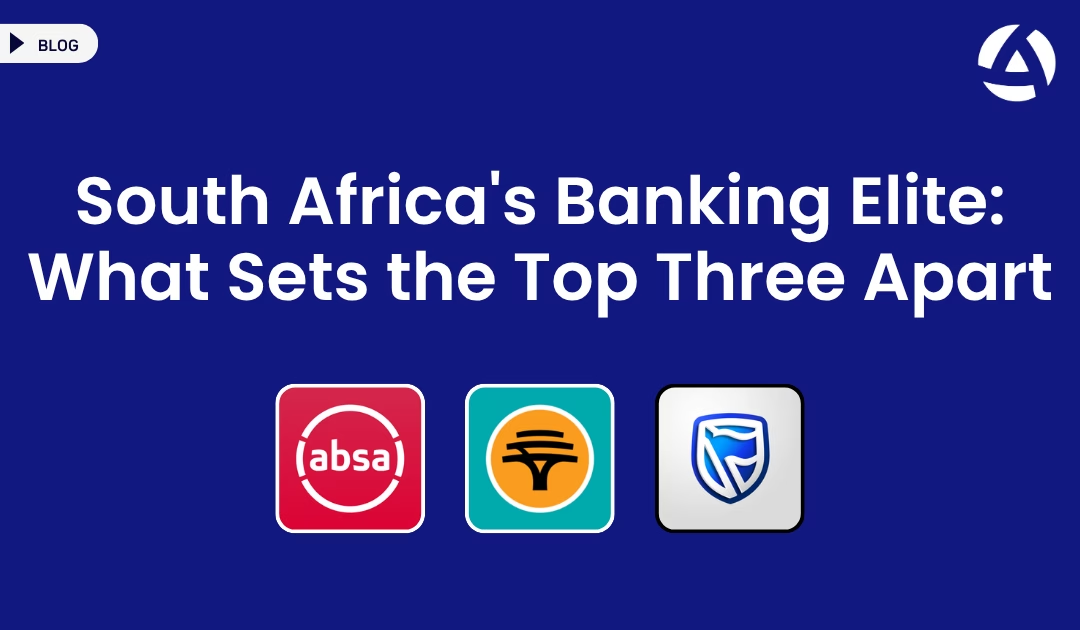
(Absa, FNB, Standard Bank)