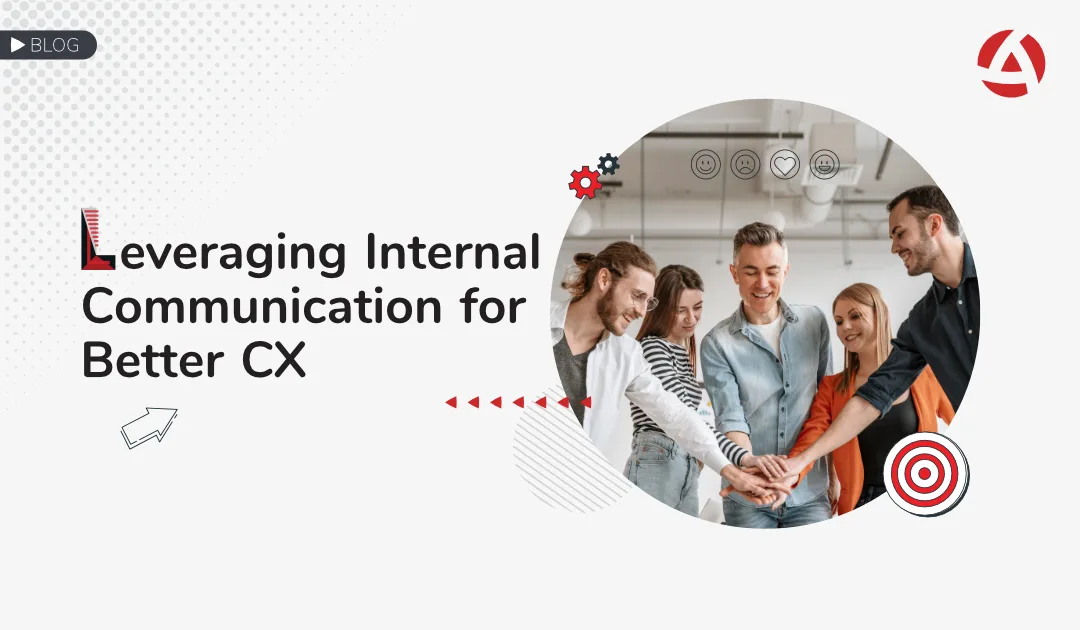
We already know that good CX quality and customer loyalty drive successful business growth. What most firms overlook is that they should prioritize the “people factor” since employees work hard to provide high-quality customer experience. The impact of employee experience on customer loyalty is an undeniable reality. From the beginning of our blog posts, we have been promoting the understanding that companies that don’t take good care of their employees cannot take care of their customers either. Although “taking good care of your employees” seems a simple task, it requires a series of actions. It is obvious that there can be different roadmaps to improve the employee experience, but we believe that one thing is common in all these different roadmaps: Transparent and effective communication.
Sharing information, ideas, and feelings between employees in a company can take place verbally or electronically in various media, such as e-mail, mobile apps, intranets, and collaboration tools. Employee communication is vital to a company’s future. The more effectively a company can execute its employee communication strategy, the more successful it will be.
A successful communication strategy may vary from company to company depending on their size, geographic location, employee demographics etc. However, there are a few universal best practices that apply to every program. An important way to ensure effective employee communication is to solicit regular employee feedback. Feedback is very important because employees will tell you what works and what doesn’t. Open feedback drives cultures through effective communication, which is a foundation for building a customer-centric environment.
How effective internal communication helps create a customer-centric organization:
Strong communication management helps to:
- Increase employee engagement: Effective communication has a direct relationship with employee engagement. Employees feel more connected to both the company and to each other when they receive the information they need to do their job efficiently. They become more productive when provided with the right tools to streamline repetitive tasks, allowing them to focus on higher-value work. Smart text automation solutions, for example, can help reduce manual effort, minimize errors, and improve workflow efficiency—enabling employees to spend more time on meaningful interactions and collaboration.
- Protect harmony in the workplace: If communication between employees and managers does not flow back and forth properly, it can lead to misunderstandings, bottlenecks, and other problems. All these problems can cause stress and adversely impact workplace harmony. Open and transparent employee communication helps prevent conflicts and resolve them quickly as they arise. This ensures a peaceful, productive workplace.
- Manage diversity: A comprehensive communication allows employees of different backgrounds, ideologies and perspectives to come together under a single purpose and function effectively as a bonded unit. When everyone feels that their voice is heard and their ideas are valued, companies can truly become customer centric.
- Empower for innovation: Employee communication fosters innovation as well as collaboration. Innovation is inevitable when team members can effectively share ideas and information among each other, listen to everyone’s perspective, and fully collaborate as a team.
- Strengthen collaboration within functions: Each department within a company works for a common vision and purpose; they are dependent on each other for total success. Therefore, it is important that departments communicate with each other for continued collaboration and support. When all departments are in sync and working in tandem, companies will thrive.
As a result, we believe that effective communication has a multiplier effect in creating a customer-centric culture, and we say that there is no excess communication when it comes to employee experience.